You’re allowed to split the work. The question is what it costs
You are generally not required to use the same contractor for the rebuild that your carrier sent for mitigation. Confirm what your emergency contract authorized, because some are written to lock you into the full rebuild. Setting that aside, treating this as a permission question misses the point.
The decision that moves your numbers is cost and timeline. A property manager who splits the work to save on the mitigation invoice can lose far more on the back end. Vacancy and displaced residents cost more than the line item you were protecting. A slower claim adds to it. The cheaper-looking path at the emergency stage is often the more expensive one by the time the building reopens.
What actually happens at the handoff between two companies
When mitigation and reconstruction sit with different companies, the same problems show up on almost every project:
- The second contractor re-scopes the loss from scratch, which repeats work and burns days.
- Investigative demolition that should have happened up front gets done late, after equipment is gone.
- The claim file breaks between vendors, so moisture data and photos go missing.
- Nobody owns the dry standard, so fault gets disputed when something is wrong.
Each of these is dead time or disputed cost, and both land on you. For a closer look at how the handoff between mitigation and reconstruction breaks down on commercial projects, the mechanics are the same whether the loss is water or fire. This is what fragmented vendor water damage work looks like in practice.
The scope gap and the re-inspection tax
The second contractor cannot trust a scope it did not build, so it starts over. On one occupied multifamily water loss, mitigation was started but never finished before a second contractor came in. That contractor spent two to three weeks on investigative cuts, opening double-layer corridor drywall and demising walls that should have been opened at the start.
Then came roughly another month going back and forth with insurance and consultants to rebuild the scope. The estimated result was three to six months of lost time. Units sat down and unoccupied, residents stayed displaced, and the cost kept compounding. Trying to save money on the front end multiplied the total.
The documentation that gets lost in the handoff
Your claim is only as strong as the file behind it. Moisture readings, drying logs, timestamped photos, and affected-area maps are what prove the loss to the carrier. When the job moves from one vendor to another, that file often does not move cleanly with it.
The ANSI/IICRC S500 standard for professional water damage restoration defines the drying and documentation a clean claim depends on. When a second contractor was not the one who took the readings, gaps appear that slow payment. That is how fragmented documentation slows a water damage insurance claim, and it is avoidable when one team carries the file the whole way.
Who is accountable when two vendors point at each other
When the building is not actually dry, someone has to answer for it, and two vendors will point at each other. The mitigation company says it dried to standard. The rebuild contractor says it inherited wet materials. You are left holding the risk and the mold that follows.
Our operations director puts the bar plainly. You have to understand how water moves through a building and be able to say with certainty, and take the liability, that it is dry. Done wrong, the costs climb fast through mold remediation and resident claims. One contractor means one party carries that liability instead of two trading blame.
The timeline math and the drying-window risk
The gap between mitigation sign-off and rebuild mobilization is dead time, and its length depends on your loss. Scope size, occupancy, environmental testing, and estimate turnaround all push it out. Do not let anyone give you a fixed day count for it, because it is a variable.
The danger in that gap is what happens to materials that are still wet. The EPA recommends drying water-damaged materials within 24 to 48 hours to prevent mold growth. If the second contractor has not mobilized and wet materials sit past that window, you risk a mold problem stacked on top of the original loss. That is the drying-window risk, and it turns a delay into a bigger scope.
Our CEO, Charlie Pappas, frames the money side through two budgets. The mitigation budget and the tenant-displacement budget are often managed by different people. Someone protecting the mitigation budget by dragging the process out misses the real math. A month of displacement versus six months can be 10 to 20 times the cost. Tie the timeline to your leasing window rather than the drying invoice.
What one contractor from emergency through rebuild actually changes
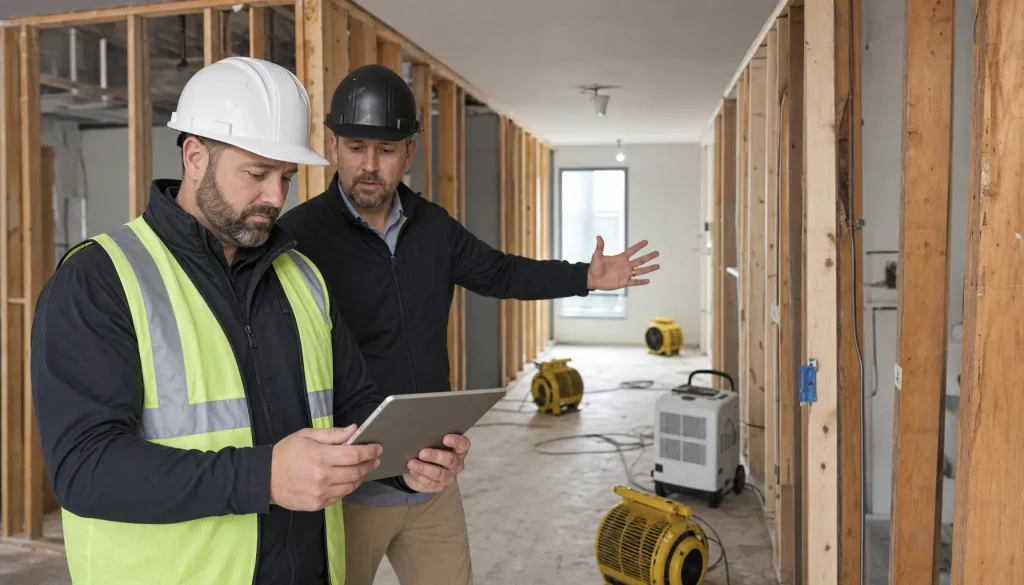
One team changes the sequence, and the sequence is where the time lives. In the fragmented model, drying finishes, everyone waits, a second contractor scopes, and the rebuild starts weeks later. With single contractor water damage restoration, the estimator is already ballparking the reconstruction while the building dries.
Our CEO describes it simply. As you plug in the first dehumidifier, you are already writing the rebuild estimate. As the last piece of equipment unplugs, the drywall starts going back up. That is one contractor under one roof, and it is why running the rebuild estimate while the building is still drying removes the handoff gap.
The same roof covers the environmental work too. Asbestos testing and abatement happen inside one schedule instead of a third handoff to another vendor. Spyder is one of the few contractors that can carry emergency services all the way through the rebuild, which is what makes the parallel estimate possible.
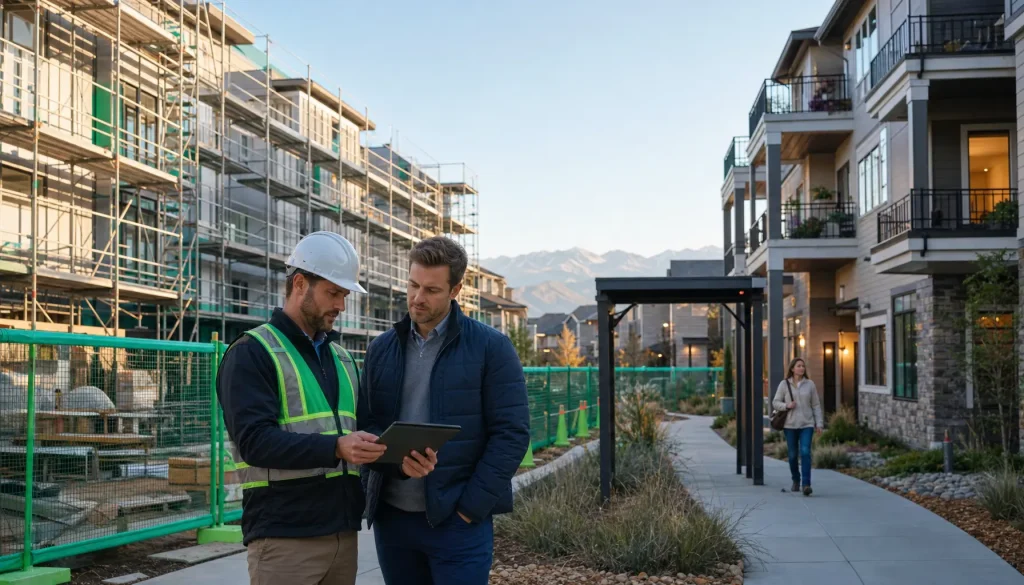
You can see the model on the Bella Terra fire restoration, where half of a 24-unit community was rebuilt while neighbors stayed in place. After a major fire, half the property was taken to the structural shell and rebuilt while adjacent residents kept living there. It returned to full occupancy faster than anticipated, which protected the asset and the rent roll.
If you are weighing how to handle a loss at one of your properties, contact our team to talk through what one contractor from emergency response through rebuild would look like.
The Colorado wrinkle most national vendors miss
In Colorado, a fragmented handoff can turn a water loss into an environmental project. Colorado’s Regulation 8 asbestos requirements mean suspect materials in older buildings have to be tested before demolition. When mitigation and rebuild are split, coordinated testing gets skipped, and demolition can disturb asbestos that nobody screened for.
Front Range weather adds more variables. Freeze-thaw swings and altitude change how materials dry, and hard freezes drive the pipe losses that start these projects. A national vendor working off a generic playbook tends to miss both.
Colorado also puts a clock on displaced residents. Colorado’s warranty of habitability requires a landlord to respond quickly to a serious habitability condition and to move toward a remedy, so every week of dead time in the handoff is a week you are exposed on both cost and compliance.
When a separate rebuild contractor is unavoidable, and how to protect the handoff
Sometimes splitting the work is the right call or the only one. A carrier may mandate a specific vendor, the scope may need a specialist, or you may have a general contractor relationship you trust. When that is the case, your job is to protect the seam between the two companies.
Require a joint scope walkthrough with both vendors before you sign off on mitigation. Secure copies of all moisture data, drying logs, and photos before anyone demobilizes. Confirm in writing who owns the dry standard, so the answer is settled before a dispute.
Watch the paperwork during the emergency. State consumer-protection agencies warn about pressure contracts and assignment-of-benefits forms that lock owners into a full rebuild signed under duress. Before you sign, read what to check in a water damage restoration contract before you sign so an emergency authorization does not quietly become a rebuild commitment.
What to confirm before you sign anything
You can protect the loss without construction expertise. Work these decision rules in order:
- If your carrier or a plumber assigns a mitigation vendor, then confirm in writing whether that vendor can also manage the reconstruction or whether you will need a separate GC.
- If a contractor puts a broad contract in front of you during the emergency, then confirm it authorizes only mitigation before you sign.
- If a handoff to a separate rebuild contractor is unavoidable, then require a joint scope walkthrough before mitigation sign-off.
- If you may switch vendors, then secure copies of all moisture data, drying logs, and photos first, because the claim depends on them.
- If moisture readings have not moved after 48 hours, then escalate to a mold protocol rather than waiting on the next contractor to mobilize.
Decide who owns the whole loss before the next one happens
Decide who owns the whole loss before the next pipe breaks, not during the 2 AM scramble. The model that removes the handoff is large-loss insurance restoration from emergency response through full rebuild, the way it worked on the Bella Terra rebuild. If you would rather not manage that handoff during your next loss, talk to our team before it happens.